

UK AI Opportunities Action Plan Explained
UK AI Opportunities Action Plan
“We want Britain to step up; to shape the AI revolution rather than wait to see how it shapes us.”
– Peter Kyle, The Secretary of State, in the Foreword to UK AI Opportunities Action Plan
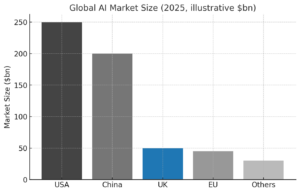
The UK is currently the third-largest AI market in the world, home to Google DeepMind, ARM, Wayve, and other AI leaders. London is a magnet for AI research, with OpenAI, Anthropic, Microsoft, and Meta all establishing major offices here. Add to that UK’s universities consistently produce top-notch AI researchers.
But there’s a gap between potential and delivery. The Action Plan identifies three big missions:
- Lay the foundations – build the infrastructure, data access, and skills pipeline.
- Change lives by embracing AI – embed AI into public services and daily life.
- Secure our future with homegrown AI – grow national champions who can compete globally.
Why an AI Opportunities Action Plan?
The government frames AI not as a nice-to-have, but as essential for its broader goals—chiefly, economic growth. Britain’s aim of achieving the highest sustained growth in the G7 is, in their view, impossible without AI.
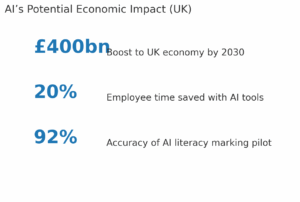
A report cited in the plan suggests AI could add £400 billion to the economy by 2030, mainly through productivity gains and new industries. Besides other real-world applications, AI technology could also cut NHS waiting lists, help teachers reduce marking time, improve police investigations, and revitalise post-industrial towns with new data centres and jobs.
That’s the dream. But dreams need a foundation. They need infrastructure.
1. Laying the Foundations: Compute, Data, and Skills
Compute Power: The New Oil
At the heart of modern AI is compute—the raw computational muscle needed to train and run models. Imagine compute as the coal of the 21st century. Just as industrial powerhouses once depended on mines and steelworks, future economies will hinge on who controls the data centres and chips. The UK currently lags far behind the US, which throws billions into supercomputing clusters, and China, which is rapidly building its own. And at an insanely high rate.
The AI Action Plan proposes:
- Expanding the AI Research Resource (AIRR) twenty-fold (20x times) by 2030.
- Establishing AI Growth Zones (AIGZs) where data centres can be built quickly with streamlined planning.
- Ensuring a mix of sovereign, domestic, and international compute—so the UK has its own reserves, private-sector muscle, and partnerships abroad.
Unlocking Data Assets
The plan is also keen to make the UK’s data—from NHS records to cultural archives—more accessible for AI training. A new National Data Library is intended to curate, protect, and release datasets.
That said, data sharing is politically tricky. Citizens worry about privacy, especially when it comes to health or personal information. And rightfully so. The plan talks about synthetic data (privacy-preserving replicas) and clear rules, but public trust will be a fragile asset. And how will this fragile asset be marshalled through ethically sound means remains to be seen.
Training the Next Generation
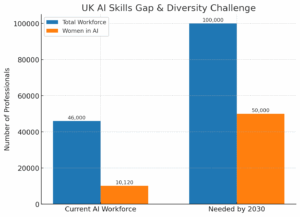
Perhaps the most ambitious section deals with skills. The government estimates we’ll need tens of thousands of extra AI professionals by 2030, and currently, supply lags demand.
Proposals include:
- New AI-focused university programmes and scholarships.
- More apprenticeships and alternative routes into AI careers.
- A prestigious AI scholarship programme—akin to Rhodes or Fulbright—to attract global talent to study in Britain.
- Expanding the Turing AI Fellowships and even creating a headhunting unit to recruit top researchers directly.
There’s also a diversity angle. At present, only 22% of AI and data science professionals are women. Closing this gap alone could unlock thousands of skilled workers.
2. Changing Lives: Bringing AI Into Daily Use
“Scan > Pilot > Scale”
The plan introduces a catchy formula: Scan > Pilot > Scale. Instead of endless reports and consultations, government departments should scan for possible AI applications, run quick pilots, then scale the ones that work.
Examples already underway:
- NHS: AI diagnostic tools are speeding up lung cancer detection, supported by a £21 million fund.
- Education: A generative AI tool piloted by the Department for Education marked Year 4 literacy work with 92% accuracy, helping teachers save time.
- Police: AI is being used to detect online threats and clean up harmful content.
The key challenge is moving beyond siloed pilots. Too often, Whitehall experiments don’t get scaled nationally. The plan calls for central funding to expand proven AI tools across the UK, avoiding the trap of fragmented systems.
Public Meets Private
A strong theme is partnership. Government is the country’s biggest buyer of services, and if it uses that purchasing power wisely, it can shape the AI market. The plan suggests new procurement rules, rapid prototyping, and making government data accessible via APIs (like Amazon’s famous mandate).
Watch Nvidia’s CEO Jensen Huang’s take on UK’s unique position in the global AI scene:
The report also calls for AI Sector Champions in industries such as life sciences, financial services, and creative industries to drive adoption.
The private sector is crucial here. Small and medium-sized enterprises (SMEs), often the slowest to adopt new tech, will need support. The government hopes AI adoption will reduce regional inequality by boosting growth outside London and the South East.
3. Securing the Future: Building UK AI Champions
This is perhaps the most political—and ambitious—part of the plan. The message is clear: we must be AI makers, not AI takers.
Currently, the most powerful AI models are built by American giants (OpenAI, Google, Anthropic) or Chinese state-backed firms. If Britain simply buys in those systems, we’ll miss out on the jobs, influence, and economic upside.
To counter this, the plan proposes creating a new body: UK Sovereign AI. Its role will be to:
- Partner with private firms to incubate and spin out frontier AI companies.
- Direct investment into strategically important AI areas (like robotics, embodied AI, and AI for science).
- Package compute, data, and visas into attractive deals for top AI talent.
- Ensure that any breakthroughs made in Britain benefit Britain, not just shareholders abroad.
It’s a bold vision, but not without risk.
The UK simply doesn’t have the fiscal firepower of the US or China, meaning every bet must be carefully placed. Still, the plan argues, Britain’s tradition of scientific excellence and regulatory credibility could make it the natural home of advanced AI development.
Regulation and Trust: Walking a Tightrope
No discussion of AI would be complete without tackling the question of safety and regulation. The UK has already earned plaudits for hosting the world’s first AI Safety Summit and launching the AI Safety Institute (AISI).
The plan wants AISI expanded, to continue its pre-deployment model testing and ensure Britain remains a global leader in AI governance. It also calls for:
- Reforming copyright and text-mining laws, so UK firms aren’t disadvantaged compared to EU rivals.
- Funding regulators to develop AI expertise.
- Publishing annual reports on how regulators are supporting safe innovation.
It’s a tricky balance. Over-regulate, and you stifle innovation. Under-regulate, and you risk public backlash when things go wrong. The plan suggests regulatory sandboxes—safe testing environments for new AI applications—as one way forward.
UK AI Action Plan – Challenges and Risks
While the Action Plan is ambitious, it acknowledgs some harsh realities:
- Investment: Britain’s AI spend is dwarfed by US and Chinese giants. Scaling up compute and scholarships will cost billions of His Majesty’s moolah.
- Public trust: Citizens remain wary of how their data is used. NHS records in particular are a political minefield. One wrong move and all Johnsons and Sunaks will become Johnsons and Sunaks.
- Skills gap: Training tens of thousands of AI experts by 2030 is easier said than done. Universities are already stretched, with UK’s university infrastructure bursting at the seams.
- Fragmentation: Without strong central leadership, pilots risk staying local and innovations lost in bureaucracy.
- Global competition: Even with Sovereign AI, Britain must attract and retain talent in a cut-throat international race.
Why It Matters for Ordinary Brits
Buried deep under the debris of policy detail, the ultimate question still remains the same: what difference will this make to people’s lives?
- Healthcare: Faster diagnoses, shorter waiting lists, more personalised treatment.
- Education: Less time marking, more time teaching, fairer assessments.
- Jobs: New opportunities in AI industries, though some traditional roles will disappear.
- Government services: A smoother, more digital experience—less paper, fewer queues.
- Regions: Potential revival of post-industrial towns if new data centres and jobs are placed outside London.
Of course, change won’t be instant. But the direction is clear: AI will be woven into the fabric of daily life. And the UK Govt is (apparently) serious in taking the first (hopefully) firm steps towards that direction.
A National Renewal Project?
The Action Plan isn’t shy about its ambition. It frames AI as more than a technology—it’s a national renewal project. Just as Victorian railways or post-war NHS transformed the country, AI is seen as a generational turning point.
But the comparison also underlines the stakes. The railway boom bankrupted investors before reshaping Britain; the NHS faced decades of funding battles. AI could similarly stumble if expectations outrun delivery – which often has been the case in UK politico-economic recent past.
Still, there’s a sense in the document that not acting is the bigger risk. In a decade’s time, AI could define global power and prosperity. Britain can either be at the table—or on the menu.
Summing Up
The UK’s AI Opportunities Action Plan is bold, detailed, and urgent. It recognises that while we cannot outspend the US or China, we can leverage our research strengths, regulatory credibility, and entrepreneurial culture.
If it works, we may see Britain shape not just its own future, but the global direction of AI—ensuring the technology boosts jobs, public services, and opportunities across society. If it fails, we risk becoming dependent on foreign systems and missing out on the most important technological revolution of our time.
The UK’s AI Opportunities Action Plan is bold, detailed, and urgent. It recognises that while we cannot outspend the US or China, we can leverage our research strengths, regulatory credibility, and entrepreneurial culture.
If it works, we may see Britain shape not just its own future, but the global direction of AI—ensuring the technology boosts jobs, public services, and opportunities across society. If it fails, we risk becoming dependent on foreign systems and missing out on the most important technological revolution of our time.
The next few years will decide whether Britain truly becomes an AI leader—or a follower. For now, the government has laid its cards on the table. How well it plays its hand still remains to be seen.